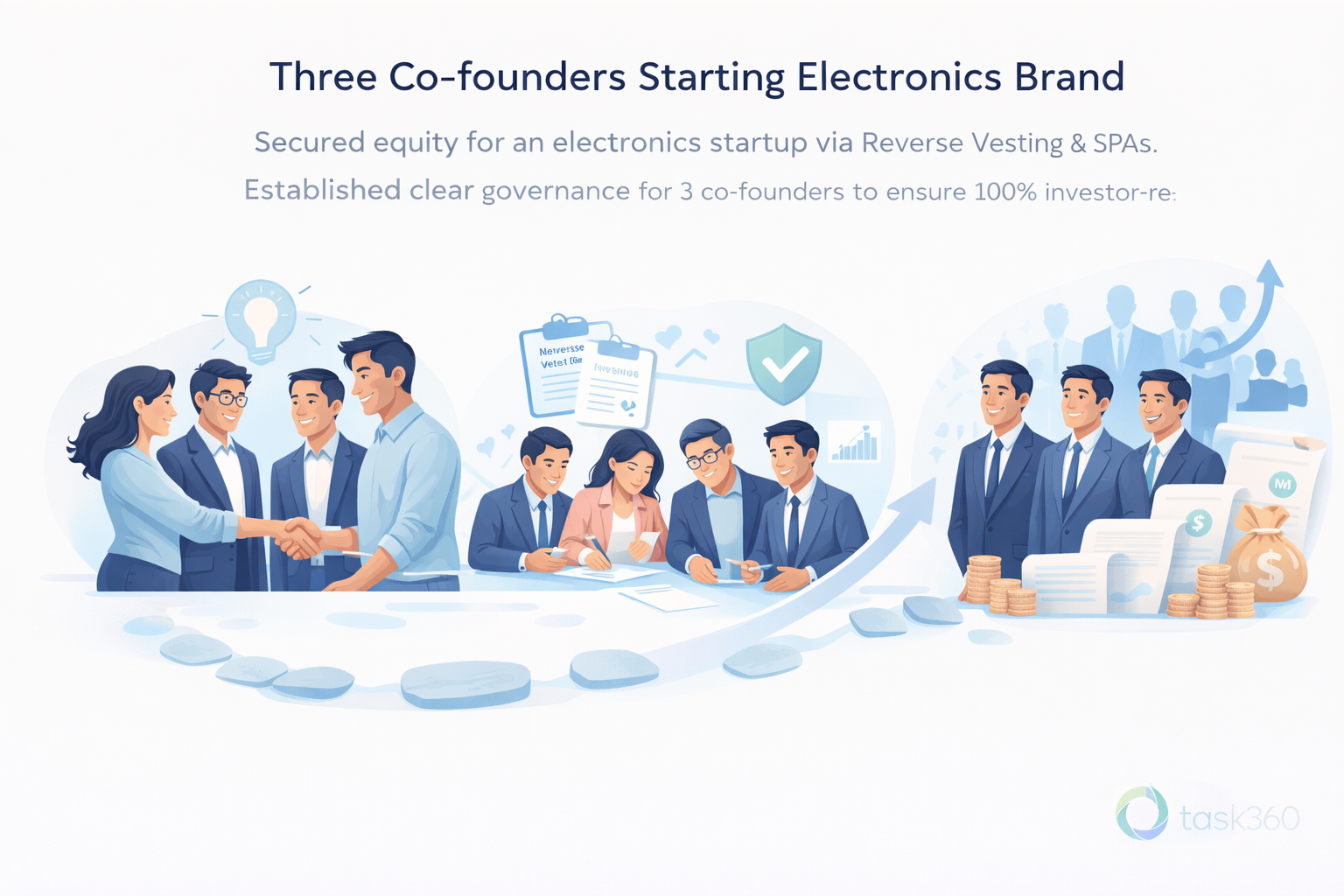
Client Profile
- Business: Smart home devices and accessories
- Founders: 3 professionals (engineering, marketing, operations backgrounds)
- Stage: Pre-revenue, just incorporated
- Funding Plans: Seed round within 12 months
The Challenge
Amit (40% - CEO, product), Neha (35% - CMO, growth), and Vikram (25% - COO, operations) had incorporated their company and divided equity based on initial contribution and roles. However:
- No written founders agreement documenting the equity split
- No vesting schedule protecting the company if someone left early
- Unclear decision-making authority (especially on hiring and spending)
- No clarity on what happens if a founder wants to leave
- Investor friends warned that VCs would demand this documentation
- Growing tension about role clarity and equity fairness
"We're childhood friends, but even friends need clear agreements. We almost had a major fallout over a hiring decision because roles weren't clear."
Our Solution
Phase 1: Detailed Consultation & Alignment (Week 1)
Conducted separate and joint sessions with all three founders to understand:
- Individual expectations and concerns
- Long-term commitment and vision alignment
- Roles, responsibilities, and authority boundaries
- Exit scenarios and fallback positions
- Investor fundraising timeline and dilution concerns
Phase 2: Comprehensive Founders Agreement (Week 2-3)
Drafted detailed agreement covering:
Equity Structure & Vesting
- Amit: 40% (1,60,000 shares)
- Neha: 35% (1,40,000 shares)
- Vikram: 25% (1,00,000 shares)
- 4-year vesting with 1-year cliff
- Monthly vesting thereafter (1/48th per month)
Reverse Vesting Mechanism
- All shares issued upfront subject to vesting
- Company right to buyback unvested shares at nominal value (₹10/share)
- Vesting accelerates 25% on Series A funding
- Double trigger acceleration on acquisition
Roles & Responsibilities
- Amit: CEO, product development, technology decisions, hiring (technical)
- Neha: CMO, marketing, brand, customer acquisition, hiring (marketing)
- Vikram: COO, operations, supply chain, vendor management, hiring (operations)
- Clear escalation matrix for disputes
Decision-Making Framework
- Unanimous consent required: Fundraising, large acquisitions, selling company, issuing new equity
- Board majority: Hiring C-level, budgets >₹10L, vendor contracts >₹5L
- CEO authority: Day-to-day operations, budgets <₹10L
- Functional authority: Each founder has final say in their domain
Exit & Termination Scenarios
Good Leaver (resignation after 1+ year, or termination without cause):
- Vested shares retained
- Unvested shares bought back at fair market value
- 6-month vesting acceleration
- Right of first refusal on share sale to co-founders
Bad Leaver (resignation before 1 year, termination for cause):
- Vested shares bought back at lower of cost or FMV
- All unvested shares bought back at nominal value
- No acceleration
Intellectual Property
- All IP developed before and during company belongs to company
- Broad non-compete and non-solicitation (1 year post-exit)
Phase 3: Supporting Documents (Week 3-4)
- Share Purchase Agreements for all three founders documenting initial purchase
- Reverse vesting deed and Articles of Association amendment
- Board resolutions approving all agreements
- IP assignment agreement from all three founders
- Updated cap table template for future rounds
The Results
Immediate Outcomes:
✅ Complete alignment on roles, equity, and decision-making
✅ Legally enforceable protection for all parties
✅ Investor-ready documentation before fundraising
✅ Prevented potential co-founder conflict
Business Impact (18 months later):
- Successfully closed ₹2.5Cr seed round from Venture Capitalist
- Investors specifically praised founder documentation
- One founder wanted to transition to advisor role (9 months in):
- Process handled smoothly per agreement terms
- Equity adjusted fairly (40% vested, buyback at FMV)
- No legal disputes or bad blood
- Hired replacement COO efficiently
- Company now valued at ₹18Cr post-money
What Could Have Gone Wrong (Without Agreement):
❌ Departing founder could claim full 25% equity despite 9 months tenure
❌ Legal battle over buyback price (nominal vs. fair market value)
❌ Investors could have walked away due to unclear cap table
❌ Company paralyzed by founder disputes on key decisions
❌ Estimated cost: ₹15-25 lakhs in legal fees + 6-12 month delay + potential company failure
Client Testimonial
“The founders agreement felt like overkill when we were just three friends excited about our idea. But when Vikram decided to pursue another opportunity 9 months in, that document saved our company. Everything was clear - how much equity he kept, the buyback price, the transition timeline. What could have been a nasty legal fight was handled in 3 weeks. Every startup needs this from day one.”
Key Takeaways
✓ Founders agreements are essential even for friends/family
✓ Reverse vesting protects the company and remaining founders
✓ Clear decision-making framework prevents daily friction
✓ Good leaver/bad leaver terms must be fair but protective
✓ Investors will not fund companies without clean founder documentation
✓ Cost: ₹50K for agreement vs. ₹20L+ for disputes later